9 Best Ice Packs for Coolers (November 2026)
The best ice packs for coolers include the Igloo Maxcold Ice Block for everyday coolers, the Cool Coolers XL Slim Ice Packs for lunch totes, and the YETI ICE Block for mixed ice loads.
On this page (8 sections)
- The best ice packs for coolers by use
- How should you choose ice packs for coolers?
- Are hard blocks or flat ice packs better?
- How do you set up and pack ice packs?
- How should you care for reusable cooler packs?
- What mistakes make ice packs less useful?
- Are reusable ice packs worth it?
- Which ice packs should you choose?
The best ice packs for coolers depend on the cooler’s size, shape and load. The Igloo Maxcold Ice Block is a strong everyday choice, while slim packs suit lunch bags and broad flat packs fit spacious coolers.
An ice pack takes up space that could hold food, drinks or loose ice. Match its footprint to the way you pack, and make sure it fits on a freezer shelf before you buy.
A broad pack can cover part of a large cooler floor, while a slim pack can sit beside a meal container. Hard blocks work well where you can use a side wall or open gap.
For help choosing the cooler itself, see our guide to hard, wheeled, soft and backpack coolers. If you’re weighing reusable packs against loose ice, read ice packs vs ice in a cooler.
Our picks at a glance
-
1

-
2

-
3

The best ice packs for coolers by use
The Igloo Maxcold Ice Block is the top pick for everyday cooler use, with other options for lunch bags, large coolers and broad coverage. Compare the shape and dimensions first, then decide how many packs your load needs.
Igloo Maxcold Ice Block: Best for everyday coolers
- Reusable Ultratherm gel block
- Two pieces
- 5.67 x 1.38 x 8.75 in
A hard block for everyday coolers, picnics and trips where you want reusable cold without melting ice water.
Pros
- Reusable gel blocks
- Two in a pack
- Compact shape for packing beside food
Cons
- Hard block shape is less flexible than flat packs
- Measure your cooler space before packing
The Igloo Maxcold Ice Block is a reusable hard block for day trips, picnics and general cooler use. Each block contains freezable Ultratherm gel, and the pack includes two blocks.
At 5.67 x 1.38 x 8.75 in, the large block is narrow enough to stand beside food containers in many coolers. Measure the inside of your cooler and freezer shelf before deciding where to store and position it.
Igloo describes the non-toxic gel as providing extended cooling and localized intense cold for items that need quick chilling. The reusable blocks also avoid the mess of melting ice.
Choose this pair if you want a rigid shape that can sit beside bottles or containers. Skip it if your cooler has only shallow gaps or you need a flexible layer that can bend around the load.
Cool Coolers XL Slim Ice Packs: Best for lunch totes
- Four slim packs
- 0.5 in thick
- BPA-free plastic
Four slim packs fit beside containers and drinks in lunch bags, insulated totes and small coolers.
Pros
- Thin profile fits narrow spaces
- Four-pack offers several placement options
- Reusable and easy to rinse
Cons
- Slim shape is aimed at bags and smaller loads
- Check dimensions against your cooler interior
Cool Coolers XL Slim Ice Packs suit lunch containers, bottles and snacks that need cold without a bulky block. Each of the four packs is 0.5 in thick, so it can fit into narrow spaces in bags and compact coolers.
Use them in a lunch bag, insulated grocery tote, beach tote or compact soft cooler. Fit & Fresh describes the plastic as BPA-free and break-resistant, and the packs are reusable and easy to rinse.
Choose this set when packing space is tight and several small pieces are easier to arrange than one large block. Skip it for a large chest cooler that needs broad cold coverage across a wide load.
YETI ICE Block: Best for mixed ice loads
- Break-resistant design
- Custom shape reduces freezing time
- 8 x 5.38 x 1.63 in
A compact, impact-resistant block that can be used alone or alongside loose ice.
Pros
- Custom shape is designed to reduce freezing time
- Break-resistant design
- Works as an ice substitute or addition
Cons
- One block per pack
- Check the size against your cooler and freezer
The YETI ICE Block can replace loose ice or work alongside it. Its custom shape is designed to reduce freezing time, and its break-resistant design suits a pack that may move around with other gear.
The 2 lb block measures 8 x 5.38 x 1.63 in. Compare those dimensions with your freezer and the space left after loading food.
YETI offers multiple sizes for different coolers, from Hopper Flip 12 to Tundra 350. This 2 lb option suits buyers who want one compact rigid pack that can join a mixed ice load.
Choose it if you want a reusable block to supplement loose ice or use on its own. Skip it if you need several low-profile packs to surround food in a small bag.
Cooler Shock Ice Packs: Best for broad coverage

- Four reusable packs
- 10 x 10 x 1 in
- Add water once before freezing
Large flat packs suit a cooler where broad cold coverage and space for food matter.
Pros
- Flat shape helps cover a broad area
- Reusable after filling with water
- Four-pack can be split across compartments
Cons
- Requires filling before first use
- Measure the interior to confirm fit
Cooler Shock is the pick for broad, flat coverage across a cooler or beach tote. Each pack measures 10 x 10 x 1 in, and the four pieces can be split between compartments or placed together.
Each pack arrives with cooling powder and needs water added once before freezing. The fill setup uses the included funnel, and the packs can be reused.
Cooler Shock says its packs have an 18°F phase change point and that a size-matched cooler can stay cold for up to 48 hours. That claim depends on cooler size and conditions, so measure the space and consider how you pack it.
Choose this set if you have a wide cooler and want several broad packs you can arrange around food. Skip it if your freezer has no room for flat packs or your cooler is too narrow for a 10 in square.
Arizona Ice Large Packs: Best for roomy coolers
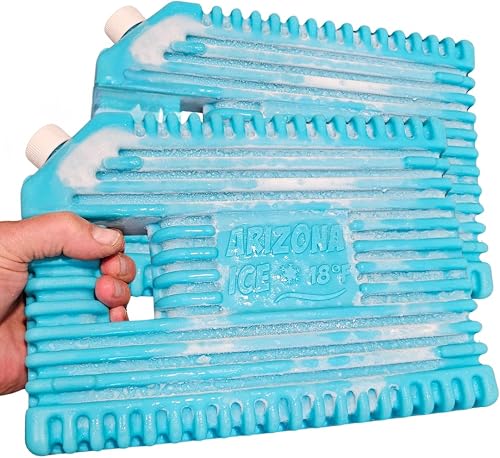
- Two 12 x 9 in packs
- Add water once
- Child-lock caps
These two large packs suit roomy coolers with space for their 12 x 9 in size.
Pros
- Large footprint suits spacious coolers
- Two reusable packs
- No funnel needed for setup
Cons
- Too large for lunch boxes and small coolers
- Needs water added before first use
Arizona Ice Large Packs suit buyers with a roomy cooler and freezer space for large packs. The two pieces measure 12 x 9 in, and setup requires adding water once before freezing.
The size is the main tradeoff. GoCJ says these packs will not fit lunch boxes or small coolers, so measure your cooler interior and freezer shelf first.
GoCJ says the packs replace 10 lb of ice and use a phase-change formula. Treat that as a brand claim, since cooling results depend on the cooler, load and conditions.
Choose Arizona Ice when you want two large packs for a spacious cooler. Skip them for lunch bags, small coolers or crowded freezers.
Igloo Medium Maxcold Ice Blocks: Best for narrow hard coolers

- Two reusable Ultratherm gel blocks
- 4.31 x 2.24 x 8 in
- Hard shell
These medium hard blocks offer reusable gel in a size that can fit more easily in a smaller cooler.
Pros
- Two reusable blocks
- Hard shell and gel design
- Narrower than the large Maxcold block
Cons
- Still needs space for a rigid block
- Compare dimensions with the cooler interior
The Igloo Medium Maxcold Ice Blocks offer reusable Ultratherm gel in a narrower hard block. The two blocks measure 4.31 x 2.24 x 8 in, making them easier to fit when the larger Maxcold block is too wide.
The hard shell contains the gel, and the blocks can be placed beside food or drinks. Igloo describes the gel as non-toxic and intended to provide extended cooling.
These are rigid blocks, so leave room for their shape when planning the load. They can suit a smaller hard cooler better than broad flat packs.
Choose this pair if you want two compact blocks for a medium cooler. Skip them if you need thin packs that can lie between stacked containers.
Healthy Packers Ice Packs: Best for bento boxes

- Four slim packs
- 7 x 4.7 x 0.5 in
- BPA-free materials
Slim reusable packs fit lunch boxes, bento boxes and smaller insulated bags where thick blocks take up too much room.
Pros
- Slim shape fits tight spaces
- Four-pack allows flexible placement
- Made for repeated use
Cons
- Small format is better for bags than large coolers
- Not a broad single-pack option
Healthy Packers Ice Packs fit lunch boxes, bento boxes and small cooler bags. Each of the four reusable packs measures 7 x 4.7 x 0.5 in, a slim profile that can slide beside containers.
The thin shape helps you place cold around food without putting a bulky block in the middle. Healthy Packers describes the packs as BPA-free and non-toxic, and they can be wiped clean or hand washed.
Choose this set for work lunches, school bags or compact travel coolers. Skip it for a large cooler where a few small packs won’t cover enough area.
Large 13 x 10 Ice Packs: Best for wide cooler floors

- Four flat packs
- 13 x 10 in
- BPA-free PP plastic
Four large flat packs suit roomy coolers and events where you want reusable packs spread across a wide area.
Pros
- Broad flat shape
- Four packs provide flexible placement
- Reusable and BPA-free
Cons
- Needs a cooler at least 13 x 11 in
- Large packs can be awkward in compact bags
These Large 13 x 10 Ice Packs suit broad cooler floors and event coolers. Four flat pieces give you several ways to arrange packs around food.
Each pack measures 13 x 10 x 2 in. Tapleap says they fit coolers with a minimum size starting at 13 x 11 in, so check your cooler’s usable inside dimensions.
Tapleap describes the packs as reusable, sealed and made of PP plastic. Its freezing-time and cooling claims depend on conditions, so freeze the packs fully and keep the cooler closed as much as practical.
Choose these for a roomy cooler where several flat packs can sit around the load. Skip them if the cooler is compact or your freezer cannot hold their broad shape.
Igloo Performance Ice Blocks: Best for large hard coolers

- 6.5 lb block
- 11.25 x 2.5 x 9 in
- Modular design
A large reusable block for medium to extra-large hard coolers, with a modular design for adding more cold packs.
Pros
- Large size suits bigger coolers
- Reusable non-toxic gel
- Modular format supports multiple blocks
Cons
- Heavy compared with smaller packs
- Too large for lunch bags and small coolers
The Igloo Performance Ice Block is a large single block, weighing 6.5 lb and measuring 11.25 x 2.5 x 9 in. Igloo describes it as suitable for medium to extra-large hard coolers.
Its modular design lets you add blocks for more coverage. Igloo recommends at least one block for a 16–30 qt hard cooler, two for a 48–75 qt cooler and three for a 94–165 qt cooler.
The block is reusable and uses non-toxic gel. Its size can suit a large cooler, but it takes up more freezer and cooler room than smaller picks.
Choose it if you have a large hard cooler and room to freeze a heavy block. Skip it for lunch bags, small coolers or any load where flexible placement matters.
How should you choose ice packs for coolers?
Choose ice packs by matching their dimensions to the cooler and the shape of your food. A broad flat pack can cover more area, but it may take space needed for meals and drinks.
Start by measuring the usable inside width, length and height. Account for containers, bottles, baskets and dividers, then check that the frozen packs fit on a freezer shelf.
For a lunch bag or small tote, slim packs can sit beside containers. Hard blocks suit coolers with open spaces along the sides, while large flat packs make more sense when you have wide surfaces to cover.
Think about the load as well as the cooler. A few bottles and meal containers need different pack placement than a cooler full of food for a group, and more packs are only useful if there is room for them to touch or sit near the contents.
Decide whether you want to use packs alone or alongside loose ice. The YETI block is explicitly designed for either role, while reusable packs can also be paired with ice if you want to fill gaps around food.
Freezer access matters too. A pack that fits inside your cooler may still be awkward to freeze if its footprint is wider than your available shelf.
Check both spaces before choosing a large format.
Are hard blocks or flat ice packs better?
Hard blocks are easy to stack or position upright, while flat packs can cover a cooler floor or sit beside food. The cooler’s interior shape should guide your choice.
The Igloo Maxcold blocks are rigid options for general cooler use. Cooler Shock, Arizona Ice and the 13 x 10 packs cover more area, but need a broad freezer shelf and open space inside the cooler.
Slim packs solve a different problem. They fit in narrow gaps around lunch containers and in bags where a thick block would push food aside.
Choose a hard block when you can reserve a clear space along the side or between larger items. Choose a flat pack when a wide surface is available, such as the bottom of a roomy cooler or a side wall with few obstructions.
If you want several placement options, a set of smaller packs can be easier to arrange than one large piece. A single large block is simpler to handle, but its position is less flexible.
How do you set up and pack ice packs?
Freeze reusable packs fully before loading them, and follow the setup steps for the pack type. Cooler Shock and Arizona Ice require water added before first use, while the other listed picks come ready to freeze.
For refillable packs, prepare them in advance rather than just before leaving. Cooler Shock includes a funnel, while Arizona Ice arrives with cooling powder and needs a one-time water fill without a funnel.
Keep packs flat in the freezer when their shape allows, and leave enough room around them so they freeze solid. If a pack still feels soft or partly liquid, give it more time before packing the cooler.
Pre-chill food and drinks before loading. Put frozen packs close to the items you want cold, then fill the cooler so there is less warm air space and the lid closes fully.
Place a pack above the load when there is room, since warm air enters from the top when you open the cooler. Keep frequently used drinks near the top so you can find them quickly and close the lid again.
Our guide to packing a cooler so food stays cold and dry covers food layers and organization. The ice retention guide explains how insulation, outside heat and lid openings affect cooling time.
How should you care for reusable cooler packs?
Rinse or hand wash packs after use, then dry them before returning them to the freezer. Igloo’s Maxcold blocks call for hand washing, and Fit & Fresh says its slim packs can be rinsed and patted dry.
Healthy Packers describes its packs as suitable for wiping with a damp cloth or hand washing. For other packs, follow the care guidance supplied with the item, and inspect caps or seams before refilling and freezing.
Store packs where they can freeze flat if their design calls for it. Keep them together in a freezer spot you can reach before a trip, so you don’t forget to refreeze them after returning home.
Avoid using a pack with a cracked shell or a damaged cap. A damaged pack may leak, so retire it instead of putting it back in contact with food.
What mistakes make ice packs less useful?
Buying by advertised cooling claims without measuring is a common mistake. A pack that does not fit the cooler or freezer creates inconvenience before the trip even begins.
Another mistake is treating one pack as enough for every cooler size. Large hard coolers have more space to cool, and Igloo recommends multiple Performance blocks for its larger cooler size ranges.
Loading warm food, leaving large empty gaps and opening the lid often can also reduce how well a cooler holds cold. Pack cold items tightly, keep the lid closed between uses and arrange the load before leaving.
Don’t choose a slim lunch pack for a wide cooler if your priority is broad coverage. Slim packs are useful because they fit around small items, while wide packs are useful because they occupy a broader surface.
Are reusable ice packs worth it?
Reusable ice packs can be worthwhile if you pack coolers often and want to avoid loose meltwater. They take freezer space and occupy fixed room inside the cooler, so their value depends on how often you use them and whether their shape fits your load.
For an occasional short trip, loose ice may be simpler to buy and pack. For regular lunches, beach days or road trips, a reusable set can be kept ready in the freezer and used again without adding water to the cooler.
The choice also depends on what you pack. If food needs to stay dry, packs make cleanup easier; if you want ice to fill gaps around containers, loose ice may be more convenient.
For a fuller comparison of the tradeoffs, read ice packs vs ice in a cooler.
Which ice packs should you choose?
Choose the Igloo Maxcold Ice Block for everyday cooler use and a simple two-block setup. Pick Cool Coolers or Healthy Packers for lunch bags and narrow gaps, and choose Cooler Shock or the 13 x 10 packs when a roomy cooler has space for flat coverage.
Arizona Ice is another large-format option if you want two wide packs and can add water before first use. Choose the Igloo Performance block for a larger hard cooler that can fit a heavy single pack, or the YETI ICE Block if you want a compact option that can work with loose ice.
Measure the cooler and freezer first, then choose the pack shape that leaves enough room for the food. For other useful gear, see our guide to cooler accessories worth buying or compare formats in our cooler type guide.
Our top 3 picks at a glance
-
1
-
2
-
3
Frequently asked questions
Are ice packs better than loose ice in a cooler?
Ice packs keep meltwater from pooling around food, while loose ice can fill gaps around containers. Ice packs take up fixed space, so choose them when dry storage or easier cleanup matters.
For a fuller comparison, see our guide to ice packs vs ice in a cooler.
How many ice packs should I use in a cooler?
Use enough packs to place cold around the food, then leave as little warm air space as practical. The right number depends on cooler size, pack dimensions, load size and how often you open the lid.
Large coolers may need several packs, while a lunch bag may need only one or two slim packs.
Should ice packs go on top or bottom?
Place cold packs around the contents, including above them when possible, because warm air enters from the top when you open the cooler. Keep food organized so the lid can close fully.
Our cooler packing guide covers layers, food placement and keeping items dry.
How long do ice packs keep a cooler cold?
There is no single time that applies to every cooler and load. Pack temperature, cooler insulation, outside heat, food temperature and lid openings all affect how long contents stay cold.
See how long ice lasts in a cooler for the factors that matter.


