8 Best Backpack Coolers (October 2026)
The best backpack coolers include the Hydro Flask Day Escape 20L for day trip carry, the TOURIT 30 Can Backpack for light loads, and the Pelican Dayventure Backpack for divided storage.
On this page (15 sections)
- Which backpack cooler is best for your trip?
- How we chose these backpack coolers
- Which backpack cooler features matter most?
- 1. Hydro Flask Day Escape 20L: Best for day trip carry
- 2. TOURIT 30 Can Backpack: Best for light loads
- 3. Pelican Dayventure Backpack: Best for divided storage
- 4. Maelstrom 35/50 Can Backpack: Best for organized group trips
- 5. Igloo Trailmate Soft Backpack: Best for quick access
- 6. SPARTER 33/49 Can Backpack: Best for separated food
- 7. Titan Deep Freeze Backpack: Best for included ice packs
- 8. Grizzly Drifter 24 Backpack: Best for rugged outings
- How do you set up and pack a backpack cooler?
- How do you care for a backpack cooler?
- What mistakes should you avoid when buying a backpack cooler?
- Which backpack cooler should you choose?
The Hydro Flask Day Escape 20L is the best backpack cooler for most day trips, thanks to its watertight zipper, welded seams and padded carry system. Choose Maelstrom to organize more small items, or the Titan if you want removable ice packs included.
A backpack cooler makes sense when you need cold food and drinks and want both hands free for walking. Your best choice depends on the walk, the size of your group, how you plan to use ice, and whether you need storage beyond the main compartment.
Capacity and carry comfort deserve equal attention. A roomy cooler may fit a group’s food, but the load gets heavier as you add drinks, containers and cold sources.
For a quick comparison with other cooler styles, see the best coolers by type. If your walk is short and you’d rather pull a cooler, compare soft coolers with wheels.
Our picks at a glance
-
1

-
2

-
3

Which backpack cooler is best for your trip?
The best backpack cooler depends on what you’ll carry and how far you’ll walk: Hydro Flask suits sealed day-trip carry, TOURIT keeps the empty pack light, and Pelican separates its storage. Maelstrom is the pick for organizing group-trip extras.
The eight choices below cover different tradeoffs, from simple access to a rugged closure. Each product card has its own details, so the guidance here focuses on the kind of buyer each one fits and the situations where it is less suitable.
How we chose these backpack coolers
We compared the stated capacity, carry design, insulation details, closure and storage layout against common day-trip needs. The strongest fit is the one that handles your usual load and walking distance without asking you to carry features you won’t use.
Capacity labels don’t always compare directly. Liter and quart measurements describe volume, while can counts may not leave room for ice, food containers or awkwardly shaped items.
The empty cooler also becomes part of your load. If you expect a longer walk, compare weights before choosing; our lightweight cooler guide explains which carry details matter.
Which backpack cooler features matter most?
A useful backpack cooler has enough space for your actual meal and cold sources, straps that suit your walk, and a closure that matches your spill risk. Extra pockets help only if you’ll use them.
| Product | Best for | Capacity | Weight | Carry | Our score |
|---|---|---|---|---|---|
| Hydro Flask Day Escape 20L | day trip carry | 20 L | 2.7 lb | Padded shoulder straps and back panel | 8.0 |
| TOURIT 30 Can Backpack | light loads | 28 L | 1.1 lb | Padded, adjustable straps | 7.9 |
| Pelican Dayventure Backpack | divided storage | 18.4 L | 3.3 lb | Padded shoulder straps | 7.8 |
| Maelstrom 35/50 Can Backpack | organized group trips | 32 L | 15.2 oz | Padded, adjustable shoulder straps and chest buckle | 7.8 |
| Igloo Trailmate Soft Backpack | quick access | 32 cans | 7.6 | ||
| SPARTER 33/49 Can Backpack | separated food | 21 L | 1.1 lb | Padded shoulder straps and back | 7.6 |
| Titan Deep Freeze Backpack | included ice packs | 24 L | 5.1 lb | Adjustable padded backpack straps | 7.5 |
| Grizzly Drifter 24 Backpack | rugged outings | 24 qt | 9 lb | Adjustable shoulder straps and padded back | 7.4 |
How much capacity should your backpack cooler have?
Choose capacity by planning a typical load before buying. A 20 L cooler can fit a modest day outing, while several 28 to 32 L picks offer more room for shared food and drinks.
Think through the contents, not only the can count. A few tall bottles or meal containers can use space differently from cans, and ice or packs reduce room for food.
Measure the items you carry most often and compare them with the cooler’s dimensions and compartment shape.
A larger bag is not automatically better for a long walk. It can invite you to pack more than you need, turning extra capacity into extra weight.
What kind of closure do you need?
Choose a closure based on whether you need to contain melted ice or simply keep contents cold during normal carrying. Hydro Flask pairs a watertight zipper with welded seams, and Grizzly uses a waterproof Tru-Zip closure with welded seams.
SPARTER states that its zipper is not leakproof, so it should stay upright and away from items that cannot get wet. TOURIT describes its liner as leak-proof, while Pelican describes its zipper as leak resistant.
Those terms are not interchangeable, so choose the stronger closure if spill containment is a priority.
When are pockets and divided compartments useful?
Pockets and dividers help when you carry utensils, phones or dry snacks alongside chilled food. Maelstrom offers the most places to sort small items, and Pelican divides its cooler space into upper and lower sections.
For simple loads, a wide main opening may be more useful than a long pocket list. The Igloo Trailmate’s wide zippered opening can make it easier to arrange food and reach what sits lower in the compartment.
How much should the empty cooler weigh?
Check the empty weight before you think about comfort with a full load. TOURIT and SPARTER weigh 1.1 lb, Hydro Flask weighs 2.7 lb, and Grizzly weighs 9 lb.
Straps and padding help distribute a load, but they cannot make a heavy cooler light. If you’ll walk farther than a few minutes, estimate the weight of the food, drinks and cold sources you plan to add, then decide whether you want to carry that load on your back.
1. Hydro Flask Day Escape 20L: Best for day trip carry
Hydro Flask Day Escape 20L: Best for day trip carry
- 20 L capacity
- 36 hours cold
- Watertight zipper and welded seams
- Self-standing molded base
A 20 L pack with a watertight zipper, welded seams and padded back panel fits day trips where hands-free carrying and leakproof transport matter.
Pros
- Watertight zipper and welded seams
- Padded shoulder straps and back panel
- Self-standing base
Cons
- Capacity is smaller than the largest picks
- Dry Storage accessories attach separately
The Hydro Flask Day Escape 20L is the best all-around choice for buyers who want a manageable day-trip size with a closure designed for leakproof transport. Its padded shoulder straps, mesh back panel and self-standing base also make loading and setting it down easier.
Hydro Flask says the cooler keeps contents cold for 36 hours. It fits 36 cans without ice, but use that figure as a rough guide: food containers and cold sources will reduce available space.
The 20 L size is a sensible fit for a couple or a modest outing. Skip it if you regularly carry provisions for a large group; a 28 to 32 L option gives you more room to work with.
2. TOURIT 30 Can Backpack: Best for light loads
TOURIT 30 Can Backpack: Best for light loads
- Holds up to 30 cans
- 1.1 lb
- Multiple front and side pockets
- 16 hours cold with ice packs
The lightweight TOURIT has a main compartment plus several pockets for small items, and TOURIT says it keeps contents cold for 16 hours with ice packs.
Pros
- Light 1.1 lb carry weight
- Several pockets for accessories
- Padded, adjustable straps
Cons
- Cold-time claim depends on ice packs
- Liner is described as leak resistant
TOURIT suits buyers who want a low-weight pack with places to keep small items separate from chilled food. It has a main compartment, front zip pockets, side mesh pockets and a pocket on the lid.
TOURIT says it keeps food and drinks cold for 16 hours with ice packs. Its 28 L capacity is described as up to 30 cans, and its padded adjustable straps and ventilated back panel support hands-free carrying.
Choose TOURIT for picnics, work lunches or outings where you value pockets and a light empty pack. Skip it if liquid containment is your top concern, since its liner is described as leak resistant rather than paired with the more clearly sealed zipper and welded-seam construction found on Hydro Flask.
3. Pelican Dayventure Backpack: Best for divided storage
Pelican Dayventure Backpack: Best for divided storage
- 18.4 L total capacity
- 13 L upper and 5.4 L lower compartments
- 840D double-coated TPU shell
- Leak-resistant zipper
Separate upper and lower compartments give the Dayventure a distinct storage layout, with a compression-molded base and padded shoulder straps.
Pros
- Two separate compartments
- Puncture-resistant outer shell
- Compression-molded base
Cons
- Smaller capacity than several picks
- Zipper is described as leak resistant
Pelican is a strong match if you want distinct upper and lower cooler sections. The upper compartment holds 13 L and the lower holds 5.4 L, which gives you a simple way to separate food groups or keep some items apart.
Its 840D double-coated TPU outer shell is described as puncture resistant, and it has a compression-molded base. The zipper is leak resistant, so keep the bag upright if melted ice or spills could cause a problem.
At 18.4 L, the Dayventure has less total room than several larger choices here. Choose it for its divided layout; skip it if you need maximum space for a group’s drinks and meals.
4. Maelstrom 35/50 Can Backpack: Best for organized group trips
Maelstrom 35/50 Can Backpack: Best for organized group trips
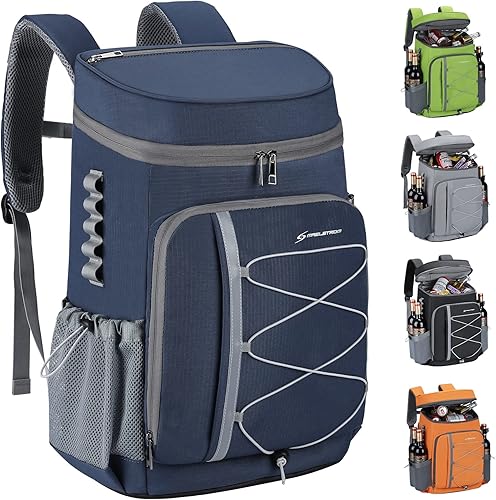
- 32 L capacity
- Holds up to 35 cans
- Multiple storage pockets
- 16 hours cold
A 32 L main compartment and pockets for utensils, cards and small valuables suit trips where organizing extras matters alongside cooler space.
Pros
- Many storage pockets
- Breathable padded back and straps
- Chest buckle with whistle
Cons
- Large pocket layout may be more than a simple day trip needs
- Cold-time claim is 16 hours
Maelstrom works well for a group outing where you’ll carry more than food and drinks. Its main cooler space is backed by multiple pockets for utensils, cards, a phone, snacks and other small items, plus mesh side pockets for bottles.
Maelstrom says the cooler keeps contents cold for 16 hours. The padded breathable back, adjustable straps and chest buckle are useful when the bag is loaded and needs to stay centered.
Pick it if you like to give every small item a place. Skip it for a simple short walk with only a few drinks; the pocket layout adds features you may not need.
5. Igloo Trailmate Soft Backpack: Best for quick access
Igloo Trailmate Soft Backpack: Best for quick access

- Holds 32 cans
- 20 mm HDPE foam insulation
- 600D coated polyester exterior
- Wide-opening main compartment
The wide zippered opening makes the main compartment easier to pack, and its padded adjustable straps support hands-free carrying.
Pros
- Wide-opening main compartment
- 20 mm foam insulation
- Dirt, sand and water resistant exterior
Cons
- Capacity is stated in cans rather than liters
- No specific cold-time duration is given
The Igloo Trailmate is a straightforward choice if you want a roomy opening and a single main compartment. Its wide zippered opening makes it easier to arrange food and reach items without moving everything at the top.
It holds 32 cans and uses 20 mm HDPE foam insulation. The coated polyester exterior is designed to resist dirt, sand and water, and the adjustable padded straps support hands-free carrying.
Choose it for easy packing and access at a beach or campsite. Skip it if you need a stated cold-time duration to plan a long day away, since Igloo does not provide one for this cooler.
6. SPARTER 33/49 Can Backpack: Best for separated food
SPARTER 33/49 Can Backpack: Best for separated food

- 21 L capacity
- Two insulated compartments
- Up to 33 cans
- 20 hours cold claim
Two insulated compartments separate drinks from dry food, while side and front pockets keep small items close.
Pros
- Two insulated compartments
- Light 1.1 lb carry weight
- Several exterior pockets
Cons
- Zipper is not leakproof
- Cold-time claim is 20 hours
SPARTER is a useful option when you want two insulated compartments for separating drinks and dry food. It has front and side pockets for smaller items, and its 21 L capacity is rated for up to 33 cans.
SPARTER says its 8 mm foam and silver PEVA seal keep contents cool for up to 20 hours. The zipper is not leakproof, so this is a poor choice if you expect the cooler to contain liquid when tipped.
At 1.1 lb, it starts light and has padded straps and a padded back. Choose it for divided food storage on a day out; skip it if you need a leakproof zipper.
7. Titan Deep Freeze Backpack: Best for included ice packs
Titan Deep Freeze Backpack: Best for included ice packs

- Holds up to 30 cans
- Two removable Ice Walls included
- Ice up to 2 days claim
- Insulated front compartment
Two removable Ice Walls fit in exterior pockets, leaving more room in the main compartment; Titan says ice can last up to 2 days.
Pros
- Two Ice Walls included
- Insulated front compartment
- Folds flat for storage
Cons
- Heaviest pick here
- Capacity is smaller than several 30-can options
Titan is the easiest choice if you want cold sources included with the cooler. Its two removable Ice Walls sit in exterior pockets, leaving more of the main compartment free for food and drinks.
The cooler holds up to 30 cans plus food and ice, with an insulated front compartment for snacks or essentials. Titan says its insulation system keeps ice up to 2 days, but cold time will vary with conditions and how often you open the cooler.
The 5.1 lb empty weight makes it the heaviest option in this roundup. Pick it if the included Ice Walls and storage layout are useful enough to justify that starting load; skip it if your priority is the lightest pack for a longer walk.
8. Grizzly Drifter 24 Backpack: Best for rugged outings
Grizzly Drifter 24 Backpack: Best for rugged outings

- 24 qt capacity
- Holds 28 cans with about 5 lb of ice
- TPU construction and welded seams
- Waterproof Tru-Zip closure
The TPU shell, welded seams and waterproof Tru-Zip closure suit buyers who prioritize a rugged, sealed build over a light pack.
Pros
- Waterproof closure
- Welded seams
- Three grab handles
Cons
- Heavier than the other picks
- Smaller can capacity than several alternatives
The Grizzly Drifter 24 fits buyers who prioritize a rugged shell and a waterproof closure over a low empty weight. TPU construction, welded seams and the Tru-Zip closure give it a more sealed design than a basic fabric cooler bag.
It holds 28 12 oz cans with about 5 lb of ice. The 24 qt capacity is useful for comparing volume, but check the cooler’s dimensions against your bottles and food containers before you commit.
The flip-top lid opens the interior fully, and padded straps, back padding and three grab handles give you different ways to move it. At 9 lb empty, skip it for a long hike or any outing where a light pack matters.
How do you set up and pack a backpack cooler?
Start with chilled food and drinks, then pack the cold sources and contents so you can reach essentials without leaving the cooler open. A little planning also helps keep a soft cooler upright and balanced while you carry it.
First, decide where each item belongs. Put food and drinks that need cooling in the insulated section, and use separate pockets only for items you want to keep away from the cold.
On SPARTER, the two insulated sections can separate categories; Pelican’s upper and lower compartments provide a similar kind of separation.
Add ice or frozen packs around the contents, leaving enough room to close the cooler without forcing the zipper. If you use a cooler with exterior ice-pack pockets, such as Titan, place the removable Ice Walls there before filling the main section.
Keep the cooler upright while packing, and put frequently used items near the top. A balanced load is easier to carry than one with dense items gathered at the front or one side.
For a more detailed packing order, follow our guide to packing a cooler.
How do you care for a backpack cooler?
Empty the cooler after each trip, remove any loose debris and clean the inside according to its care instructions. TOURIT and Maelstrom call for hand washing, while Titan’s care guidance says to wipe it with a damp cloth.
Let the interior dry fully before storage so trapped moisture does not linger. Keep zippers clear of crumbs and grit, and avoid forcing them if the cooler is overfilled or contents are caught in the closure.
A soft cooler is easiest to keep in good shape when it isn’t carrying more than it can close comfortably. Store it folded only if its design allows it; Titan specifically has a fold-flat design.
What mistakes should you avoid when buying a backpack cooler?
The most common buying mistakes are choosing by can count alone, overlooking the empty weight and expecting every zipper to contain leaks. A cooler that misses any one of those needs can be frustrating even if its capacity seems right.
- Treating the can count as usable food space: Ice, packs and meal containers take room. Picture your real load before comparing capacities.
- Ignoring empty weight: A heavy cooler becomes harder to manage once full. Grizzly’s 9 lb empty weight is a clear reason to choose another pack for long walks.
- Assuming “leak resistant” means waterproof: Compare the exact closure language and keep a soft cooler upright, especially when the zipper is not leakproof.
- Buying more pockets than you’ll use: Maelstrom’s many pockets help organize extras, but a simpler bag can be easier to pack if you carry only lunch and drinks.
- Relying on a cold-time claim as a guarantee: Brands state durations under particular conditions. Start with chilled contents, use enough ice or packs and limit warm-air exposure.
Which backpack cooler should you choose?
Choose the Hydro Flask Day Escape 20L for a balanced day-trip pack with a self-standing base and a watertight zipper. Pick TOURIT for a lightweight, pocket-rich carry, Pelican for separate compartments, Maelstrom for organizing group-trip extras, or Titan if you want removable ice packs included.
Choose Grizzly when its rugged closure matters more than its 9 lb empty weight, or Igloo when a wide opening and simple compartment are your priorities. If you’re still weighing a backpack against other cooler types, use our best cooler styles guide to choose the carry format that fits your trip.
Our top 3 picks at a glance
-
1
-
2
-
3
Frequently asked questions
What size backpack cooler should I get?
Choose capacity based on the food and drinks you carry, plus space for ice or ice packs. A smaller 20 L pack can suit a day outing, while 28 to 32 L options offer more room for shared trips.
Can counts are estimates, so compare the shape of your usual containers with the cooler's dimensions.
Are backpack coolers leakproof?
Some have sealed zippers and welded seams, while others describe their liners as leak resistant. The Hydro Flask has a watertight zipper and welded seams; SPARTER says its zipper is not leakproof.
Keep the pack upright if its closure is not designed to seal against tipping.
Do backpack coolers keep food cold all day?
Cold time depends on the cooler, ice or ice packs, starting temperature and how often you open it. The products here make different duration claims, from 16 hours with ice packs to up to 2 days for the Titan.
Treat those as brand claims and pack enough cold sources for your trip.
How should I pack a backpack cooler?
Chill food and drinks first, then add ice or frozen packs around the contents and limit empty air space. Keep items you need often near the top so you don't leave the cooler open while searching.
Our guide to packing a cooler covers a simple order for food, drinks and cold sources.


